The Fall of the House of Usher With Read Text Option and Follow Guide for Students
| The Fall of the House of Usher | |
|---|---|
| by Edgar Allan Poe | |
 First appearance in Burton'due south Gentleman's Magazine (September 1839) | |
| Country | Usa |
| Language | English |
| Genre(s) | Horror, Gothic |
| Published in | Burton's Admirer'due south Mag |
| Publication date | September 1839 |
"The Fall of the Firm of Usher" is a short story by American writer Edgar Allan Poe, get-go published in 1839 in Burton's Admirer'due south Mag, then included in the collection Tales of the Grotesque and Arabesque in 1840.[one] The short story, a work of Gothic fiction, includes themes of madness, family, isolation, and metaphysical identities.[2]
Plot [edit]
The story begins with the unnamed narrator arriving at the house of his friend, Roderick Usher, having received a alphabetic character from him in a afar part of the country lament of an illness and request for his help. Every bit he arrives, the narrator notices a sparse crevice extending from the roof, downwards the front of the house and into the adjacent tarn, or lake.
It is revealed that Roderick'southward sister, Madeline, is also ill and falls into cataleptic, deathlike trances. Roderick and Madeline are the only remaining members of the Usher family.
The narrator is impressed with Roderick's paintings and attempts to cheer him past reading with him and listening to his improvised musical compositions on the guitar. Roderick sings "The Haunted Palace", then tells the narrator that he believes the house he lives in to be alive, and that this sentience arises from the system of the masonry and vegetation surrounding it. Further, Roderick believes that his fate is connected to the family unit mansion.
Roderick later informs the narrator that Madeline has died. Fearing that her body volition be exhumed for medical study, Roderick insists that she be entombed for two weeks in the family tomb located in the house before being permanently buried. The narrator helps Roderick put Madeline's body in the tomb, whereupon the narrator realizes that Madeline and Roderick are twins. The narrator besides notes that Madeline'southward torso has rosy cheeks, which sometimes happens after death. Over the next week, both Roderick and the narrator discover themselves increasingly agitated.
A storm begins, and Roderick comes to the narrator'due south sleeping accommodation (which is situated directly above the house's vault) in an well-nigh hysterical state. Throwing the windows open up to the storm, Roderick points out that the lake surrounding the house seems to glow in the dark, just every bit Roderick depicted in his paintings, but in that location is no lightning or other explainable source for the glow.
The narrator attempts to calm Roderick downwardly by reading aloud from a medieval romance entitled The Mad Trist, a novel involving a knight named Ethelred who breaks into a hermit'south dwelling in an attempt to escape an budgeted tempest, merely to find a palace of aureate guarded past a dragon. Ethelred also finds a shining brass shield hanging on a wall. Upon the shield is inscribed:
Who entereth herein, a conquistador hath bin;
Who slayeth the dragon, the shield he shall win;[1]
Ethelred swings his mace at the dragon, which dies with a piercing shriek. When he attempts to take the shield from the wall, it falls to the floor with an unnerving clatter.
Every bit the narrator reads of the knight'south forcible entry into the dwelling, he and Roderick hear cracking and ripping sounds from somewhere in the business firm. When the dragon'southward death cries are described, a real shriek is heard, again inside the house. As he relates the shield falling from off the wall, a hollow metallic reverberation tin can be heard throughout the firm. At first, the narrator ignores the noises, simply Roderick becomes increasingly hysterical. Roderick somewhen declares that he has been hearing these sounds for days, and that they are existence made by his sister, who was in fact alive when she was entombed.
The bedroom door is then diddled open to reveal Madeline, bloodied from her backbreaking escape from the tomb. In a final fit of rage, she attacks her brother, scaring him to death every bit she herself expires. The narrator then runs from the firm, and, equally he does, he notices a flash of moonlight behind him. He turns back in time to encounter the moon shining through the suddenly widened scissure in the house. As he watches, the Business firm of Conductor splits in two and the fragments sink away into the lake.
Character descriptions [edit]
Narrator [edit]
In "The Fall of the House of Conductor", Poe'due south unnamed narrator is called to visit the House of Usher by Roderick Usher. Equally his "all-time and only friend,"[3] Roderick writes of his illness and asks that the narrator visit him. The narrator is persuaded by Roderick'southward desperation for companionship. Though sympathetic and helpful, the narrator is continually made to be an outsider, watching the narrative unfold without fully becoming a part of it. The narrator besides exists as Roderick's audition as the men take not remained close. Roderick is convinced of his impending demise and the narrator gradually is drawn into this conventionalities after being brought forth to witness the horrors and hauntings of the Business firm of Usher.[four]
From his inflow, the narrator notes the family'due south isolationist tendencies, equally well as the cryptic and special connection between Madeline and Roderick, the last living members of the Conductor family. Throughout the tale and her varying states of consciousness, Madeline completely ignores the narrator's presence. After Roderick Conductor claims that Madeline has died, the narrator helps Usher entomb Madeline in an underground vault despite noticing Madeline's flushed, lifelike appearance.
During one sleepless dark, the narrator reads aloud to Usher equally eerie sounds are heard throughout the mansion. He witnesses Madeline'due south reemergence and the subsequent, simultaneous death of the twins. The narrator is the just grapheme to escape the Firm of Usher, which he views every bit it cracks and sinks into the mountain lake.
Roderick Conductor [edit]
Roderick Usher is the twin of Madeline Usher and 1 of the last living members of the Usher family. Roderick writes to the narrator, his boyhood friend, about an ongoing illness.[3] When the narrator arrives, he is startled to see Roderick'due south eerie and off-putting advent. He is described by the narrator equally having:
greyness-white pare; eyes large and full of low-cal; lips not vivid in colour, but of a beautiful shape; a well-shaped nose; hair of corking softness — a face up that was not easy to forget. And now the increase in this strangeness of his face up had caused so dandy a change that I almost did not know him. The horrible white of his skin, and the strange light in his eyes, surprised me and even fabricated me agape. His hair had been immune to grow, and in its softness information technology did not fall effectually his face merely seemed to lie upon the air. I could not, even with an endeavour, see in my friend the appearance of a simple human being beingness.[5]
Roderick Conductor is a recluse.[3] He is unwell both physically and mentally. In add-on to his abiding fear and trepidation, Madeline'due south catalepsy contributes to his decay equally he is tormented by the sorrow of watching his sibling die. The narrator states:
He admitted [that] much of the peculiar gloom which thus affected him could be traced [to] the plain budgeted dissolution [of] his sole companion.[3]
According to Terry W. Thompson, Roderick meticulously plans for Madeline's burial to prevent "resurrection men" from stealing his beloved sister's corpse for autopsy, study, or experimentation equally was common in the 18th and 19th centuries for medical schools and physicians in need of cadavers.[6]
Equally his twin, the two share an incommunicable connection that critics conclude may be either incestuous or metaphysical,[7] as two individuals in an extra-sensory relationship embodying a unmarried entity. To that terminate, Roderick's deteriorating condition speeds his ain torment and eventual decease.
Like Madeline, Roderick is continued to the mansion, the titular Business firm of Usher. He believes the mansion is sentient and responsible, in part, for his deteriorating mental wellness and melancholy. Despite this admission, Usher remains in the mansion and composes art containing the Conductor mansion or similar haunted mansions. His mental health deteriorates faster as he begins to hear Madeline's attempts to escape the underground vault she was buried in, and he eventually meets his decease out of fear in a manner similar to the House of Usher's great and sinking.
Madeline Usher [edit]
Madeline Usher is the twin sister of Roderick Usher. She is deathly ill and cataleptic. She appears near the narrator, but never acknowledges his presence. She returns to her bedroom where Roderick claims she has died. The narrator and Roderick place her in a tomb despite her flushed, lively appearance. In the tale'southward conclusion, Madeline escapes from the tomb and returns to Roderick, scaring him to death.
Co-ordinate to Poe'due south detective methodology in literature, Madeline Usher may be the physical embodiment of the supernatural and metaphysical worlds.[ citation needed ] Her express presence is explained equally a personification of Roderick's torment and fear.[ citation needed ] Madeline does not announced until she is summoned through her brother's fear, foreshadowed in the epigraph, with a quote from French poet Pierre-Jean de Béranger: "Son cœur est un luth suspendu; / Sitôt qu'on le touche il résonne", meaning "His heart is a tightened lute; as soon as i touches it, it echoes".[one] [ citation needed ]
Publication history [edit]
"The Fall of the House of Usher" was first published in September 1839 in Burton's Gentleman's Magazine. Information technology was revised slightly in 1840 for the drove Tales of the Grotesque and Arabesque. It contains Poe's verse form "The Haunted Palace", which earlier was published separately in the April 1839 result of Baltimore Museum.[8]
In 1928, Éditions Narcisse, predecessor to the Black Lord's day Press, published a express edition of 300 numbered copies with illustrations by Alastair.[ citation needed ]
Sources of inspiration [edit]

Poe's inspiration for the story may exist based upon events of the Hezekiah Usher Firm, which was located on the Usher estate that is at present a three-block area in downtown modernistic Boston, Massachusetts.[9] Adjacent to Boston Mutual and jump by Tremont Street to the northwest, Washington Street to the southeast, Avery Street to the due south and Wintertime Street to the north, the business firm was synthetic in 1684 and either torn downwards or relocated in 1830.[9] Other sources point that a sailor and the immature wife of the older owner were caught and entombed in their trysting spot past her husband. When the Usher Firm was torn downwards in 1830, two bodies were found embraced in a cavity in the cellar.[10]
Some other source of inspiration may be from an bodily couple, Mr. and Mrs. Luke Usher, the friends and acting colleagues of his mother Eliza Poe.[eleven] The couple took intendance of Eliza'southward three children (including Poe) during her time of illness and eventual death.[ citation needed ]
German author E.T.A. Hoffmann, who was a role model and inspiration for Poe, published the story "Das Majorat" in 1819.[ citation needed ] There are many similarities between the two stories, including the physical breaking of a house, eerie sounds in the dark, the story within a story and the house owner's being chosen Roderich or Roderick. Because Poe was familiar with Hoffmann's works, he knew the story and drew from information technology using the elements for his own purposes.[12]
Some other German author, Heinrich Clauren's, 1812 story The Robber'southward Castle, as translated into English past John Hardman and published in Blackwood'due south Magazine in 1828 as "The Robber's Tower", may have served equally an inspiration, according to Arno Schmidt and Thomas Hansen.[13] Equally well as sharing common elements, such as a young woman with a fright of premature burial interred in a sepulcher direct beneath the protagonist'southward bedchamber, stringed instruments, and the living twin of the cached girl, Diane Hoeveler identifies textual evidence of Poe'southward use of the story, and concludes that the inclusion of Vigiliae Mortuorum secundum Chorum Ecclesiae Maguntinae (Vigils for the Dead according to the Use of the Church of Mainz) is fatigued from the apply of a similarly obscure volume in "The Robber's Tower".[two] [14]
The theme of the crumbling, haunted castle is a key characteristic of Horace Walpole's Castle of Otranto (1764), which largely contributed in defining the Gothic genre.[fifteen]
Assay [edit]
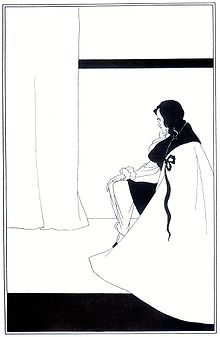
"The Autumn of the Firm of Usher" is considered the best case of Poe's "totality", wherein every chemical element and detail is related and relevant.[xvi]
The presence of a capacious, disintegrating house symbolizing the devastation of the human body continues to be a characteristic element in Poe'south later on work.[15]
"The Fall of the Business firm of Usher" shows Poe'southward ability to create an emotional tone in his work, specifically emphasizing feelings of fright, impending doom, and guilt.[17] These emotions center on Roderick Usher, who, like many Poe characters, suffers from an unnamed disease. Like the narrator in "The Tell-Tale Heart", this disease inflames Roderick'south hyperactive senses. The illness manifests physically but is based in Roderick's mental or even moral country. He is sick, it is suggested, because he expects to exist sick based on his family's history of disease and is, therefore, essentially a hypochondriac.[eighteen] Similarly, he buries his sis live because he expects to bury her alive, creating his own self-fulfilling prophecy.[ commendation needed ]
The House of Usher, itself doubly referring both to the actual structure and the family, plays a significant role in the story. It is the first "graphic symbol" that the narrator introduces to the reader, presented with a humanized description: Its windows are described equally "eye-like" twice in the first paragraph. The scissure that develops in its side is symbolic of the decay of the Usher family and the firm "dies" along with the two Usher siblings. This connexion was emphasized in Roderick's verse form "The Haunted Palace", which seems to be a straight reference to the business firm that foreshadows doom.[19]
L. Sprague de Camp in his Lovecraft: A Biography wrote that "[a]ccording to the late [Poe good] Thomas O. Mabbott, H.P. Lovecraft, in 'Supernatural Horror', solved a trouble in the interpretation of Poe" by arguing that "Roderick Usher, his sis Madeline, and the house all shared 1 mutual soul".[20]
The plot of this tale has prompted many critics to analyze it as a clarification of the human being psyche, comparing, for example, the House to the unconscious, and its key crack to a split personality.[ citation needed ] An incestuous relationship between Roderick and Madeline never is explicitly stated, simply seems implied by the attachment between the ii siblings.[21]
Opium, which Poe mentions several times in both his prose and poems, is mentioned twice in the tale.[i] The gloomy sensation occasioned by the dreary mural around the Usher mansion is compared by the narrator to the sickness caused by the withdrawal symptoms of an opiate-aficionado. The narrator also describes Roderick Usher'south advent as that of an "irreclaimable eater of opium."[22]
Allusions and references [edit]
- The opening epigraph quotes "Le Refus" (1831) by the French songwriter Pierre-Jean de Béranger, translated to English language as "his eye is a suspended lute, as before long every bit it is touched, it resounds".[ane] Béranger's original text reads "Mon cœur" (my heart) and not "Son cœur" (his/her eye).[ commendation needed ]
- The narrator describes one of Usher's musical compositions as a "singular perversion and distension of the wild air of the final waltz of Von Weber". Poe here refers to a popular piano work of his fourth dimension – which, though going by the title "Weber's Last Waltz" was actually composed past Carl Gottlieb Reissiger.[23] A manuscript copy of the music was institute amidst Weber's papers upon his death in 1826 and the work was mistakenly attributed to him.
- Usher's painting reminds the narrator of the Swiss-born British painter Henry Fuseli.
Usher'southward library is mentioned to accept "formed no small portion of the mental existence of the invalid [Roderick Conductor]." A list of titles is provided in the story, all of which are allusions to real-globe works. Several notable examples include:
- The Belphegor of Machiavelli, a tale involving demonic possession.
- Emanuel Swedenborg'southward Heaven and Hell, a volume about divine visions and the afterlife.
- Directorium Inquisitorum, a list of heretical forbidden works.
- "Civitas Solis", a poem about a theological society within the dominicus. The poet Tommaso Campanella believed that the world has a spiritual nature.[24]
Literary significance and criticism [edit]

"The Fall of the Firm of Usher" outset appeared in Burton's.
Along with "The Tell-Tale Heart", "The Blackness Cat", and "The Cask of Amontillado", "The Fall of the Business firm of Conductor" is considered among Poe's more famous works of prose.[25] As G.R. Thomson writes in his introduction to Peachy Short Works of Edgar Allan Poe,
"the tale has long been hailed as a masterpiece of Gothic horror; it is besides a masterpiece of dramatic irony and structural symbolism."[26]
"The Autumn of the Firm of Usher" has been criticized for being too formulaic.[ citation needed ] Poe was criticized for following his own patterns established in works like "Morella" and "Ligeia", using stock characters in stock scenes and stock situations. Repetitive themes like an unidentifiable disease, madness, and resurrection are also criticized.[27] Washington Irving explained to Poe in a letter dated Nov six, 1839:
"You have been too anxious to present your pictures vividly to the eye, or too distrustful of your result, and had laid on likewise much colouring. It is erring on the best side – the side of luxuriance."[28]
John McAleer maintained that Herman Melville's thought for "objectifying Ahab's flawed graphic symbol" in Moby-Dick came from the "evocative force" of Poe's "The Fall of the Firm of Usher". In both Ahab and the house of Usher, the appearance of fundamental soundness is visibly flawed – past Ahab's livid scar, and by the fissure in the masonry of Conductor.[29]
In other media [edit]
In film [edit]
La Chute de la maison Usher is a 1928 silent French horror film directed by Jean Epstein starring Marguerite Gance, Jean Debucourt, and Charles Lamy.
A 2d silent motion picture version, also released in 1928, was directed by James Sibley Watson and Melville Webber.
A devout fan of the works of Poe, cult managing director Curtis Harrington tackled the story in his starting time and last films. Casting himself in dual roles as Roderick and Madeline Usher in both versions, Harrington shot his original 10-minute silent short on 8mm in 1942,[30] and he shot a new 36 infinitesimal version simply titled Usher on 35mm[30] in 2000 which he intended to utilise in a longer Poe anthology film that never came to fruition.[31] Both versions were included on the 2013 DVD/Blu-ray release Curtis Harrington: The Brusk Motion picture Collection.
In the Roger Corman motion picture from 1960, released in the The states every bit Firm of Usher, Vincent Toll starred as Roderick Usher, Myrna Fahey as Madeline and Marking Damon as Philip Winthrop, Madeline's fiancée. The moving-picture show was Corman'south start in a series of 8 films inspired by the works of Edgar Allan Poe.
The 2006 motion-picture show The House of Conductor from Australian director Hayley Cloake, starring Austin Nichols as Roderick Conductor, was an update of the tale set in the modern era with a love involvement for Roderick in the form of the best friend of his deceased sister.[32]
In 1979 Italian state channel RAI loosely adapted the short story, together with other Poe'due south works, in the serial I racconti fantastici di Edgar Allan Poe.[33] It was directed by Daniele D'Anza, with Roderick Conductor played by Philippe Leroy; music was composed past pop ring Pooh.
In theater, animation and music [edit]
From 1908 to 1917, French composer Claude Debussy worked on an opera titled La chute de la maison Usher.
The Fall of the Firm of Usher is another operatic version, equanimous by Philip Drinking glass in 1987 with a libretto by Arthur Yorinks, premiered at the American Repertory Theatre and the Kentucky Opera in 1988 and was revived at the Nashville Opera in 2009.[34] The Long Embankment Opera mounted a version of this work in February 2013 at the Warner Grand Theatre in San Pedro, Los Angeles.[35]
The Fall of the Firm of Usher is an opera composed by Peter Hammill with a libretto past Chris Judge Smith released in 1991 on Some Bizzare Records; in 1999, Hammill revised his work and released it every bit The Fall of the House of Usher (Deconstructed & Rebuilt). This opera has never been performed alive.
In 2002 Lance Tait wrote a one-act play The Fall of the House of Usher, based on Poe's tale. Laura Grace Pattillo wrote in The Edgar Allan Poe Review (2006), "[Tait's] play follows Poe'due south original story quite closely, using a female Chorus effigy to help further the tale as the 'Friend' (equally Tait names the narrator) alternates between monologue and conversation with Usher."[36]
In 2008, a musical adaptation ("Conductor") won the Best Musical award at the New York International Fringe Festival.[37] [38] [39]
The Fall of the House of Usher (2015), narrated by Christopher Lee, is an animated brusque motion-picture show which is part of Boggling Tales.[40] [41]
Netflix series [edit]
On October half dozen, 2022 it was announced that Intrepid Pictures volition create an viii episode express series titled The Fall of the House of Usher for Netflix that volition be based on the works of Edgar Allan Poe. Mike Flanagan and Michael Fimognari will each directly four episodes and executive produce the series.[42]
References [edit]
- ^ a b c d e Poe, Edgar A. "The Fall of the Business firm of Usher." 1839. Elements of Literature. Fifth Course. Austin: Holt, Rinehart, and Winston, 2009. 321–33. Print.[ ISBN missing ]
- ^ a b Perry, Dennis; Sederholm, Carl (2009). Poe, "The House of Usher," and the American Gothic. Palgrave Macmillan. pp. nine–10. ISBN9780230620827.
- ^ a b c d Poe, Edgar Allan (2013). Edgar Allan Poe: Storyteller. Washington, DC: Office of English language Language Programs. p. 23. ISBN978-1-624-25061-three.
- ^ Rollanson, Christopher (June 2009). "The Character of Phantasm: Edgar Allan Poe'south 'The Fall of the House of Conductor' and Jorge Luis Borges' 'Tlön, Uqbar, Orbis Tertius.'". Atlantis. 31: 9–22 – via EBSCOhost.
- ^ Poe, Edgar Allan (2013). Edgar Allan Poe: Storyteller. Washington, DC: Part of English Linguistic communication Programs. p. 24. ISBN978-1-624-25061-3.
- ^ Thompson, Terry (Leap 2018). "With Sympathy for Roderick: Madeline Conductor and the Resurrection Men". Midwest Quarterly. 59: 255–67 – via EBSCOhost.
- ^ Lovecraft, Howard (1973). Supernatural Horror in Literature. New York: Dover Publications. ISBN0-486-20105-viii. [ page needed ]
- ^ Sova, Dawn B. Edgar Allan Poe: A to Z. Checkmark Books, 2001: 104. ISBN 0-8160-4161-X
- ^ a b An Celebrated Corner, Tremont Street and Temple Identify by Walter K. Watkins, in Days and Ways in Old Boston past William S. Rossiter (ed.), Boston: R.H. Stearns & Co., 1915, pp. 91–132[ ISBN missing ]
- ^ A.I.A. Guide to Boston. Susan and Michael Southworth, p. 59
- ^ Allen, Hervey. Israfel: The Life and Times of Edgar Allan Poe. New York: Farrar & Rinehart, Inc., 1934: 683.[ ISBN missing ]
- ^ Hoffmann, E. T. A. (1990). Kaiser, Gerhard R. (ed.). Nachtstücke. Stuttgart: Philipp Reclam. ISBN978-iii-xv-000154-seven. [ folio needed ]
- ^ Hansen, Thomas S. (Spring 1992). "Poe's 'German language' Source for 'The Autumn of the House of Usher': The Arno Schmidt Connection". Southern Humanities Review. 26 (two): 101–13.
- ^ Hoeveler, Diane Long (2008). "Reading Poe Reading Blackwood's: The Palimpsestic Subtext in "The Fall of the House of Usher"". In Lewes, Darby (ed.). Double Vision: Literary Palimpsests of the Eighteenth and Nineteenth Centuries. Lexington Books. pp. 227–29. ISBN9780739125694.
- ^ a b Hutchisson, James M. Poe, Jackson, Mississippi: University of Mississippi Printing, 2005, p. 38.[ ISBN missing ]
- ^ Beebe, Maurice. "The Universe of Roderick Usher" equally nerveless in Poe: A Drove of Disquisitional Essays, Robert Regan, ed. Englewood Cliffs, NJ: Prentice Hall, Inc., 1967. p. 123.[ ISBN missing ]
- ^ Meyers, Jeffrey. Edgar Allan Poe: His Life and Legacy. New York City: Cooper Square Press, 1992; ISBN 0-8154-1038-7, p. 111
- ^ Butler, David. "Usher's Hypochondriasis: Mental Alienation and Romantic Idealism in Poe's Gothic Tales", collected in On Poe: The Best from "American Literature. Durham, NC: Duke University Press, 1993. ISBN 0-8223-1311-ane, pp. 189–ninety.
- ^ Meyers, Jeffrey. Edgar Allan Poe: His Life and Legacy. New York Urban center: Cooper Square Press, 1992. ISBN 0-8154-1038-7 p. 111.
- ^ de Camp, 50. Sprague, Lovecraft: A Biography (Doubleday, 1975).[ ISBN missing ] [ page needed ]
- ^ Hoffman, Daniel. Poe Poe Poe Poe Poe Poe Poe. Baton Rouge: Louisiana State University Press, 1972. ISBN 0-8071-2321-8 p. 297.
- ^ Hayter, Alethea (2015). Opium and the Romantic Imagination. London: Faber & Faber. Chapter VI: Poe. ISBN9780571306015.
- ^ "Edgar Allan Poe Order of Baltimore – General Topics – A Few Minor Poe Topics". eapoe.org.
- ^ Mabbott, Thomas Ollive (1973). "The Books in the House of Conductor". Books at Iowa. nineteen: iii–7. doi:10.17077/0006-7474.1059. ISSN 0006-7474.
- ^ Kennedy, J. Gerald. "Introduction: Poe in Our Time" collected in A Historical Guide to Edgar Allan Poe. Oxford University Press, 2001; ISBN 0-19-512150-3 p. 9
- ^ Thomson, Yard.R. Great Brusque Works of Edgar Allan Poe (HarperCollins, 1970), p. 36.
- ^ Krutch, Joseph Wood. Edgar Allan Poe: A Study in Genius. New York: Alfred A. Knopf, 1926. p. 77
- ^ The Best Horror Brusk Stories 1800–1849: A Archetype Horror Album Editor Andrew Barger Annotated Edition Publisher Bottletree Books LLC, 2010 ISBN 978-1-933747-22-4, Length 233, p. 179
- ^ McAleer, John J. "Poe and Gothic Elements in Moby-Dick", Emerson Order Quarterly, No. 27 (II Quarter 1962): p. 34.
- ^ a b Toscano, Marking (2013). Conversations in the Dorsum of the Theatre: Preserving the Short films of Curtis Harrington (DVD Booklet). Elevate Metropolis/Flicker Alley.
- ^ "Retrospective in Terror: An Interview with Curtis Harrington". Terror Trap. April 2005. Retrieved 2014-03-22 .
- ^ "The House of Usher".
- ^ "I racconti fantastici di Edgar Allan Poe -". xix December 2020.
- ^ Waleson, Heidi (November 24, 2009). "Two by Philip Glass". The Wall Street Journal . Retrieved November 29, 2010.
- ^ Ginell, Richard. "Review: Long Beach Opera charts 'The Fall of the Firm of Usher'". Los Angeles Times . Retrieved February five, 2013.
- ^ Pattillo, Laura Grace (Bound 2006). "The Autumn of the Business firm of Usher and Other Plays Inspired by Edgar Allan Poe". The Edgar Allan Poe Review. 7 (i): fourscore–82. JSTOR 41506252.
- ^ Dorof, Jacob (ix September 2008). "Two Eli productions stand out at New York's Fringe". Yale Daily News.
- ^ Trav, Southward.D. (August 12, 2008). "Fringe Festival 2008 Reviews!". The Village Voice.
- ^ Siegal, Barbara. "Usher-- the musical, not the person who seats you". Talkin' Broadway . Retrieved December 27, 2017.
- ^ Young, Deborah (March 26, 2015). "'Extraordinary tales': Hong Kong Review". The Hollywood Reporter.
- ^ "Extraordinary tales in the Haifa film festival". Archived from the original on 2015-10-07.
- ^ Squires, John. ""The Fall of the Business firm of Usher": Netflix and Mike Flanagan Developing Serial Based on Edgar Allan Poe Stories!". Bloody Disgusting . Retrieved October half dozen, 2017.
Further reading [edit]
- Evans, Walter (1977). "'The Fall of the House of Usher' and Poe'southward Theory of the Tale". Studies in Brusque Fiction. 14 (2): 137–44. Rpt. in Short Story Criticism. Ed. Laurie Lanzen Harris and Sheila Fitzgerald. Vol. one. Detroit: Gale, 1988. 403–05.
External links [edit]
- The Fall of the House of Conductor at Project Gutenberg
- The Fall of the Business firm of Usher at Project Gutenberg (audiobook)
-
 The Autumn of the Business firm of Usher public domain audiobook at LibriVox
 - Full text equally reprinted in The Works of the Late Edgar Allan Poe (1850)
- Full text at Bartleby.com
- "The Fall of the House of Usher" with annotated vocabulary at PoeStories.com
- Full text at American Literature
- Assay past Martha Womack
- William B. Cairns (1920). . Encyclopedia Americana.
Source: https://en.wikipedia.org/wiki/The_Fall_of_the_House_of_Usher
0 Response to "The Fall of the House of Usher With Read Text Option and Follow Guide for Students"
Postar um comentário