What Style of Art Did Paul Klee Do Famous Artists From Wisconsin
Information technology's no secret that artists oftentimes look to other artistic figures, styles, and movements for inspiration. In addition to fine art influences, all the same, many of fine art history's most prominent players likewise employed more than personal muses. Much like Frida Kahlo's involvement in her Mexican heritage and Salvador Dalí'south dive into his subconscious, painterPaul Klee, for example, was influenced past his own musical background.
When paired with more than art-geared influences, Klee's knowledge of music allowed him to develop a distinctive style unlike any other. Here, we explore the artist'southward life and one-of-a-kind work in order to illustrate his undeniable affect on modern art.
Who is Paul Klee?
Paul Klee (1879-1940) was a Swiss-born creative person. Involved with and influenced past several unlike movements—including Expressionism, Cubism, and Surrealism—Klee excelled in a range of genres, including cartoon, printmaking, and, virtually famously, painting. Similarly, he inventively employed unexpected materials to produce mixed-media works, from canvas and cardboard to foil and material.
His avant-garde approach to art landed him a teaching job at the famous Bauhaus School. Every bit he led bookbinding, stained glass, and mural painting workshops, it is during this 10-year teaching stint that he developed a signature painting technique. "He started every picture show with an abstract mark—a foursquare, a triangle, a circumvolve, a line or a dot—and and so allowed that motif to evolve or grow, nigh like a living organism," explains art historian Richard Dorment.
Dorment is non the only one who viewed Klee'due south paintings every bit sentient beings. In fact, Klee himself made the comparison. "Pictures take their skeleton, muscles, and skin like homo beings," he explained in 1908. "One may speak of the specific beefcake of the picture. A motion picture representing 'a naked person' must not be created by the laws of human anatomy, but simply by those of compositional anatomy."
While Klee had an anatomical arroyo to limerick, the content of his works was inspired by an entirely different subject area: music.
Musical Background

Like many famous fine artists, Klee was built-in into a creative family. Different near of his peers, however, Klee'southward parents were non experts in painting, cartoon, or sculpting; instead, they were musically-inclined. Specifically, his begetter was a music instructor, while his mother was a vocalizer.
Klee, at first, followed in his parents' footsteps. Every bit a immature child, he adult a gustation for classical music, with works by composers similar Johann Sebastian Bach and Wolfgang Amadeus Mozart amidst his favorite pieces. At the age of 7, he began playing the violin, culminating in a stint every bit a violinist for the Bern Symphony Orchestra while he was in his 20s.
Though on a promising path, Klee decided to forego a musical career and instead pursue art by the turn of the century—though music would remain an important muse for much of his career. In 1905, nearly a decade after changing career paths, he revealed: "More and more parallels between music and graphic art force themselves upon my consciousness."
This enduring connexion to his earliest craft manifests equally paintings that direct reference music. InIn the Style of Bach(1919), for example, Klee reimagines a musical score as an arrangement of graphic symbols similar leaf, a crescent moon, and stars. In addition to deciphering the structural similarities between music and art, however, Klee discovered a more profound connection betwixt the disciplines when he began to explore colour theory.
Colour Theory
In 1914, Klee traveled to Tunisia. Inspired by the vibrancy of the sights that surrounded him, it is here that he made his biggest artistic quantum: an appreciation for color. "Color has taken possession of me; no longer do I have to chase after it, I know that it has hold of me forever," he said. "Color and I are one. I am a painter."
Inspired past this revelation, he obsessively studied and tinkered with colour for several years. While employed by the Bauhaus, he "developed his ain color theory based on a half dozen-function rainbow shaped into a color wheel," Bauhaus100 explains. "He placed the complementary colors in relation to movements that collaborate with one another, which shows this theory is based on dynamic transitions."
Information technology is when Klee mixed his unique arroyo to color with his musical groundwork that he was able to establish a style that was entirely his own. Some of his works—like Polyphony (1932), a painting that explores musical texture through tonal blocks, and Harmony in Blue-Orange (1923), a slice that pairs gratuitous colors as if they were music notes—direct insinuate to both elements. Still, many of his well-nigh famous pieces—including Fish Magic (1925) andTo the Parnassus (1932)—demonstrate his harmonious approach to colour theory without specific references, proving his power to "improvise freely on the keyboard of colors."
Klee Today
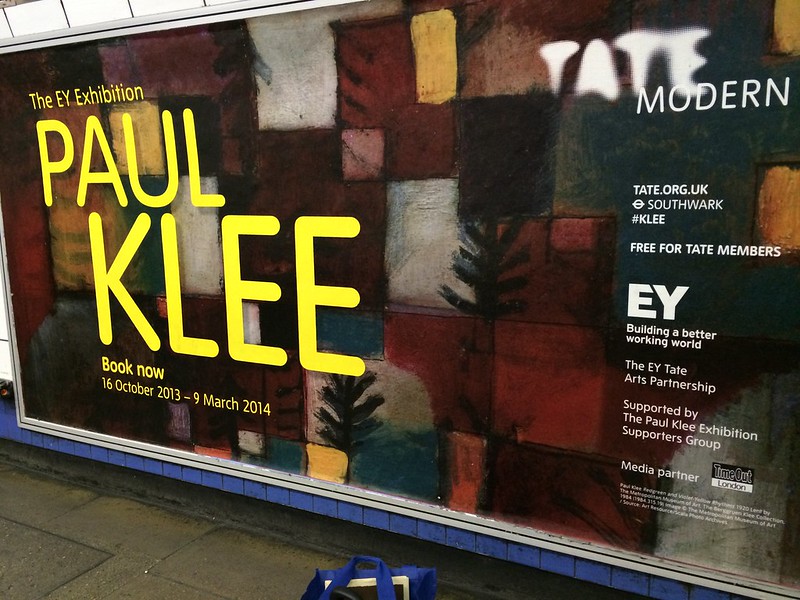
Today, Klee is known every bit a master of both modernist color and form. In recent years, his exceptional oeuvre has been the subject of much study, culminating in highly-anticipated exhibitions around the globe. Notable retrospectives includePaul Klee. Irony at Piece of work at Paris' Pompidou Center and Paul Klee — Making Visible at the Tate Modernistic in London.
In improver to museums, Klee's legacy can be constitute in the classroom. In the middle of the 20th century, his Bauhaus lectures were compiled into a two-volume tome and published asWritings on Form and Blueprint Theory and, after, asThe Paul Klee Notebooks. Likened to Leonardo'southward A Treatise on Paintingand described past famed art historian Herbert Read equally "the most complete presentation of the principles of design always made past a modern artist," The Paul Klee Notebooksremain a crucial resource for gimmicky creatives—in the fine arts and beyond.
Related Manufactures:
30 Vivid Quotes Nigh Art From Famous Artists and Swell Creative Minds
10+ Famous Watercolor Artists Who Continue to Influence Painting Today
How the Pioneers of Pointillism Continue to Influence Artists Today
Source: https://mymodernmet.com/paul-klee-art-and-music/
0 Response to "What Style of Art Did Paul Klee Do Famous Artists From Wisconsin"
Postar um comentário