Longclaws Eyes Closed When Jon Was in theã¯â»â¿ Water Then He Came Out and Longclaws Eyes Opened Again
Blogs
Why do we meet colors with our eyes airtight?
Those mysterious blobs and patterns that bedazzle the backs of your eyelids are no illusion. What you meet is real low-cal — and it'due south coming from within your optics.
• December 29, 2014
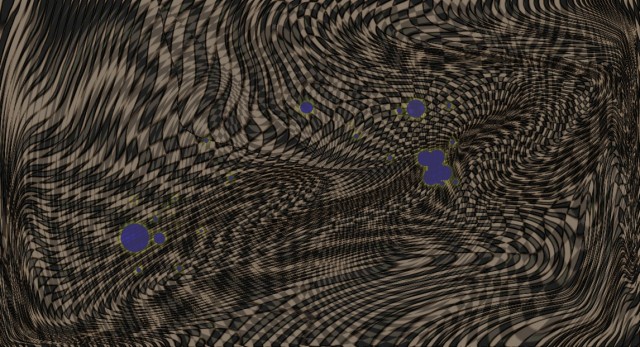
Phosphenes can announced every bit geometric patterns as well every bit random spots of colour. This is an artist's rendition of what they look like. [Paradigm Credit: Wikimedia Commons user Al2]
As you settle into bed at night, close your eyes and begin to doze off, y'all may detect the colorful light evidence happening inside your eyelids. When yous rub the sleep from your weary eyes, the lights suddenly intensify and bursts of bright colors appear all across your field of vision. A few seconds after, the colors settle down once more. While you might appreciate the bedtime entertainment, in the back of your drowsy mind yous've probably wondered what the heck yous're even seeing.
These strange blobs yous encounter have a name; they're chosen "phosphenes," and researchers believe that actual light may play a role. Simply non ordinary light — this light comes from inside your eyes. In the same mode that fireflies and abyssal creatures can glow, cells within our eyes emit biophotons, or biologically produced lite particles.
"We come across biophotonic lite inside our eyes in the aforementioned way we see photons from external calorie-free," said István Bókkon, a Hungarian neuroscientist who works at the Vision Research Constitute in Lowell, Massachusetts.
Biophotons be in your eyes because your atoms constantly emit and absorb tiny particles of lite, or photons. This photon commutation is just a part of normal cellular function. Your optics can't tell the divergence between photons from exterior calorie-free and the biophotons emitted past your own atoms. Either manner, your optic nerve simply relays these light signals to the brain, which must then decide if information technology accurately represents the existent world effectually you, or if it's just a phosphene.
Our eyes actually produce far more biophotons than nosotros end up seeing as phosphenes. "When you lot rub your eyes, this generates biophotons in many parts of the eyes," explained Bókkon. "But they are more often than not absorbed locally." Virtually all of the biophotons y'all see are the ones both emitted and absorbed by atoms in the retina — the part of your eye responsible for detecting light.
Inside the retina, millions of tiny cells called rods and cones collect low-cal and convert it into electric signals. These signals travel through the optic nervus to a part of the brain called the visual cortex. Here, the brain reconstructs an image using the information received from the optics. When a reconstructed image looks similar nonsense, the brain is quick to label the image every bit unreal, or a phosphene.
But that information doesn't always come up from your retinas. According to Bókkon, phosphenes can originate in various other parts of the visual organization, too. Research has shown that directly electric and magnetic stimulation of the brain can trigger phosphenes, and Bókkon hopes to before long be able to testify that biophotons are responsible for these phosphenes likewise.
Depending on where a phosphene originates, it can take on a variety of shapes, patterns and colors. Different atoms and molecules emit photons of different wavelengths, which is why we encounter different colors. A phosphene with an orderly geometric pattern like a checkerboard may have originated in a section of the retina where millions of light-collecting cells are arranged in a similarly organized design. Researchers have also plant that different areas of the brain's visual cortex create certain specific shapes of phosphenes.
In the 1950s, the German researcher Max Knoll at the Technische Universität in Munich came upward with a classification scheme for phosphene shapes. He studied phosphenes in over a thousand volunteers and came upwards with xv categories, including triangles, stars, spirals, spots and baggy blobs. He discovered that by prodding dissimilar areas of the visual cortex with an electrode device, he was consistently able to induce the same kinds of phosphenes.
In the lab, scientists generally use electric probes and fancy magnetic machines to brand people come across phosphenes. But the phosphenes we mostly come across every solar day are not related to any type of electromagnetic stimulation. Instead, nigh phosphenes occur spontaneously when the atoms in our eyes exchange their biophotons. Y'all can also trigger phosphenes yourself past applying force per unit area to your optics — but exist careful trying this at home!
The most common non-spontaneous phosphenes are pressure phosphenes, similar the ones y'all run into when y'all rub your eyes. According to Bókkon, any blazon of pressure level on the optics can cause them to emit an "excess of biophotons" that create intense visuals. Sneezing really difficult, getting whacked in the head, and standing upwards too fast (causing a drop in blood pressure level) are also means to trigger pressure phosphenes.
The but people who never encounter phosphenes are people who have been bullheaded since nativity. But people who lose their vision due to illnesses or injuries usually don't lose all visual functions. Because phosphenes tin originate in different parts of the visual organization, "theoretically, all bullheaded people who could previously see can retain the ability to see phosphenes," explained Bókkon.
Researchers have also been studying ways to trigger phosphenes in blind patients to endeavour and figure out a way to potentially restore their vision. If scientists can use technology to make the blind see phosphenes, mayhap they tin can utilise similar technology make them see real images.
So next time y'all crawl into bed, close your eyes and admire the phosphenes. Now that you tin can appreciate the visual effects in a whole new mode, you can just lay back and savor the bear witness.
Source: https://scienceline.org/2014/12/why-do-we-see-colors-with-our-eyes-closed/
0 Response to "Longclaws Eyes Closed When Jon Was in theã¯â»â¿ Water Then He Came Out and Longclaws Eyes Opened Again"
Postar um comentário